
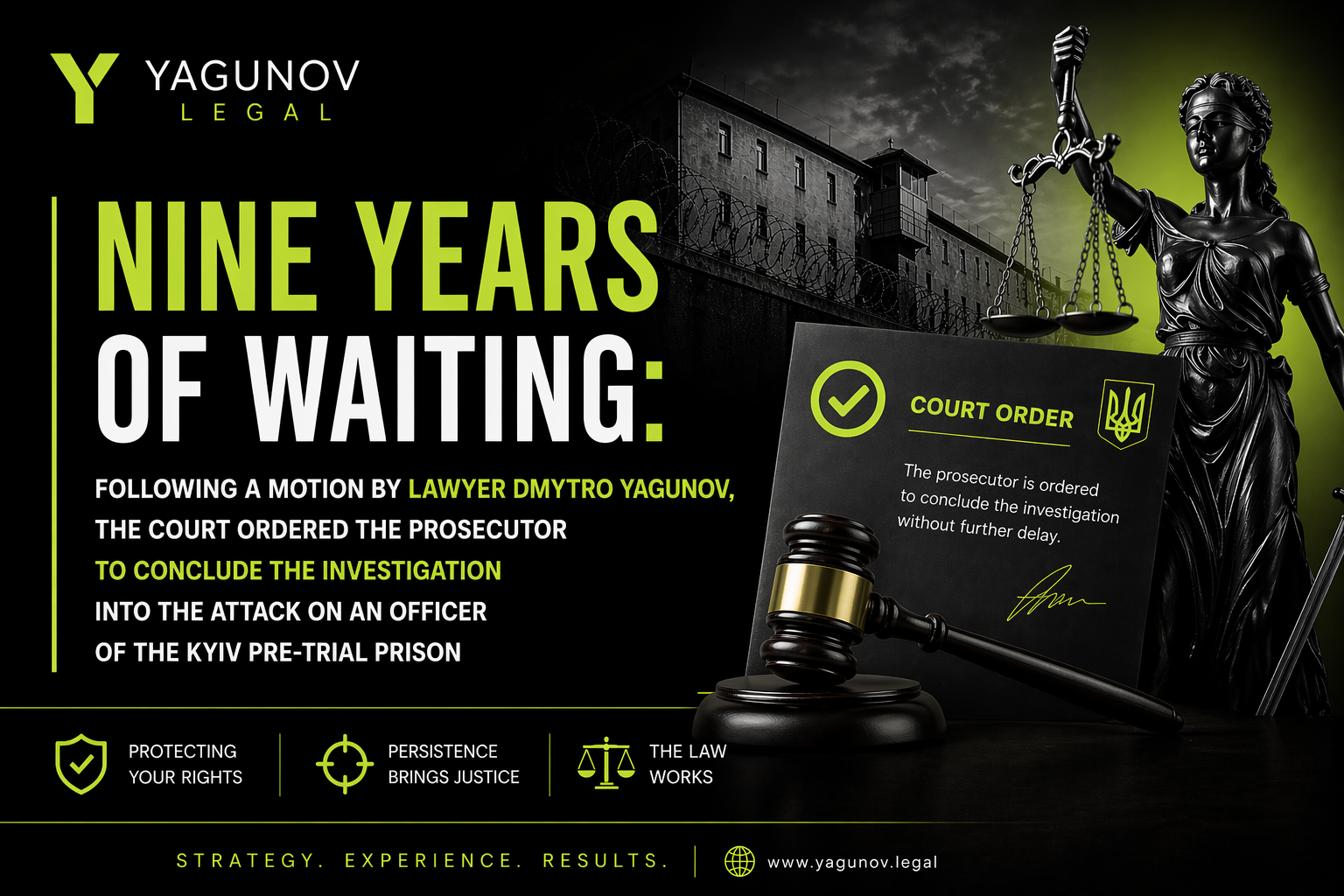
Nine Years of Waiting: Following a Motion by Lawyer Dmytro Yagunov, the Court Ordered the Prosecutor to Conclude the Investigation into the Attack on an Officer of the Kyiv Pre-Trial Prison
In the prison systems of various countries there exists a phenomenon well known to criminologists but rarely entering mainstream public discourse: violence against prison staff or police officers committed not out of personal motives and not for the purpose of escape – but to elevate one’s informal status within the criminal hierarchy of inmates.
This is not a speculative construct. The Council of Europe’s Committee for the Prevention of Torture (CPT) has documented this pattern across the practices of various states. In particular, following a visit to Moldova, the CPT delegation recorded that a significant number of inmates felt the need to “assert themselves” while still held in juvenile facilities – in order to acquire an appropriate “rank” within the informal hierarchy by the time of their transfer to adult institutions. The beatings that occurred at Moldovian Prison were directly linked to precisely this dynamic.
A similar logic underlies the case examined in Ukraine. A pre-trial detention centre officer was attacked by a group of inmates: he was subjected to torture, deliberate abandonment in a life-threatening condition, and denial of medical assistance. According to one version of events, the immediate purpose of the crime was to elevate the attackers’ informal standing within the prison’s informal hierarchy.
Criminal proceedings were opened almost immediately after the incident. Yet for many years they effectively stood still: no person was served with a notice of suspicion, and no final procedural decision was taken. Numerous attempts by the victim’s advocate to advance the case were met either with refusals or with the return of motions without consideration.
Eventually the case reached an investigating judge, who conducted a systematic analysis of whether the duration of the pre-trial investigation met the reasonable time standard enshrined in Article 6 of the Convention for the Protection of Human Rights and in Article 28 of the Code of Criminal Procedure of Ukraine. The court drew on the case law of the European Court of Human Rights – in particular, the criteria for assessing the reasonableness of timeframes as formulated in a series of judgments against Ukraine and other Council of Europe member states. The conclusion was unequivocal: the investigation was being conducted in manifest violation of reasonable time requirements, and the prosecution had offered no reasoned explanation for the protracted delay.
On the basis of this review, the court granted the motion and set the prosecutor a specific deadline for completing the investigation and issuing a procedural decision.
This ruling is not merely a procedural victory in a single case. It sends a clear signal: the rights of penitentiary staff who become victims of crimes committed directly in connection with the performance of their official duties are no less deserving of protection than the rights of any other victim. The state cannot sabotage an investigation for years on end – and remain free of consequences.
Advocate Dmytro Yagunov, who represented the victim’s interests, has many years of experience defending the rights of individuals whose cases lie at the intersection of penitentiary law, CPT standards, and the jurisprudence of the European Court of Human Rights. This case is yet further confirmation that a persistent legal position can compel the system to move – even where inertia has reigned for years.