How to Measure the Severity of the Bar Disciplinary System? The Punitivity Index: The First Experience of Application
This article analyses the state of disciplinary liability of advocates in Ukraine for 2023–2025 on the basis of data from the High Qualification and Disciplinary Commission of the Bar (HQDCB) and regional qualification and disciplinary commissions of the bar (QDCB). Using the author’s analytical tool — the punitiveness index — the qualitative severity of disciplinary practice is studied in dynamics.
INTRODUCTION AND PROBLEM STATEMENT
Research into disciplinary practices concerning advocates in Ukraine remains an underdeveloped area of legal scholarship. In April 2026, a systematic empirical analysis of the state of disciplinary practices — in terms of the availability of public data and the overall effectiveness of existing mechanisms — was conducted by M. Bereza and Ya. Kuzyshyn. The authors identified three key challenges — incapacity, opacity, and ineffectiveness — and substantiated them on the basis of publicly documented facts.
However, a descriptive approach to the analysis of statistical data has obvious limitations: absolute quantitative indicators do not reflect the qualitative severity of disciplinary practice. Two bodies with the same number of sanctions may have fundamentally different punitive logic — if one predominantly issues warnings while the other suspends or disbars advocates. It is precisely to overcome this analytical deficit that the punitiveness index has been proposed.
The purpose of this article is to apply the punitiveness index to aggregated national data on the disciplinary practice of QDCBs for 2023–2025 and to identify trends that remain hidden under purely quantitative analysis.
METHODOLOGY: THE PUNITIVENESS INDEX
The central analytical tool of the study is the punitiveness index (PI) — an indicator that reflects the qualitative severity of the disciplinary practice of a specific body, regardless of the total volume of proceedings. The calculation formula is unified: PI = (n_medium × 1 + n_serious × 2) / (N × 2) where n_medium is the number of medium-severity sanctions (suspension of the right to practice); n_serious is the number of the most severe sanctions (disbarment); N is the total number of sanctions.
The theoretical range of the index is from 0 (all sanctions are warnings) to 1.0 (all sanctions are disbarments). A PI value within 0–0.25 indicates predominantly lenient disciplinary practice; 0.25–0.50 indicates moderate practice; 0.50–0.75 indicates elevated severity; above 0.75 indicates harsh punitive logic.
The weighting structure of the formula reflects the qualitative hierarchy of sanctions: a warning receives no weight as it is the least burdensome measure; suspension of the right to practice receives a weight of 1 (medium-severity sanction); disbarment receives a weight of 2 (the most severe sanction). The denominator N×2 normalises the value to the range [0;1] on the assumption that each sanction could theoretically carry the maximum weight of 2.
The data source is the publicly available aggregated statistics of the HQDCB cited in the study by M. Bereza and Ya. Kuzyshyn. It should be noted that the HQDCB declined to respond to the authors’ information request concerning its own decisions on annulling QDCB decisions, which makes it impossible to adjust the indicators presented. This limitation is taken into account when interpreting the results.
OVERALL DYNAMICS: ABSOLUTE INDICATORS
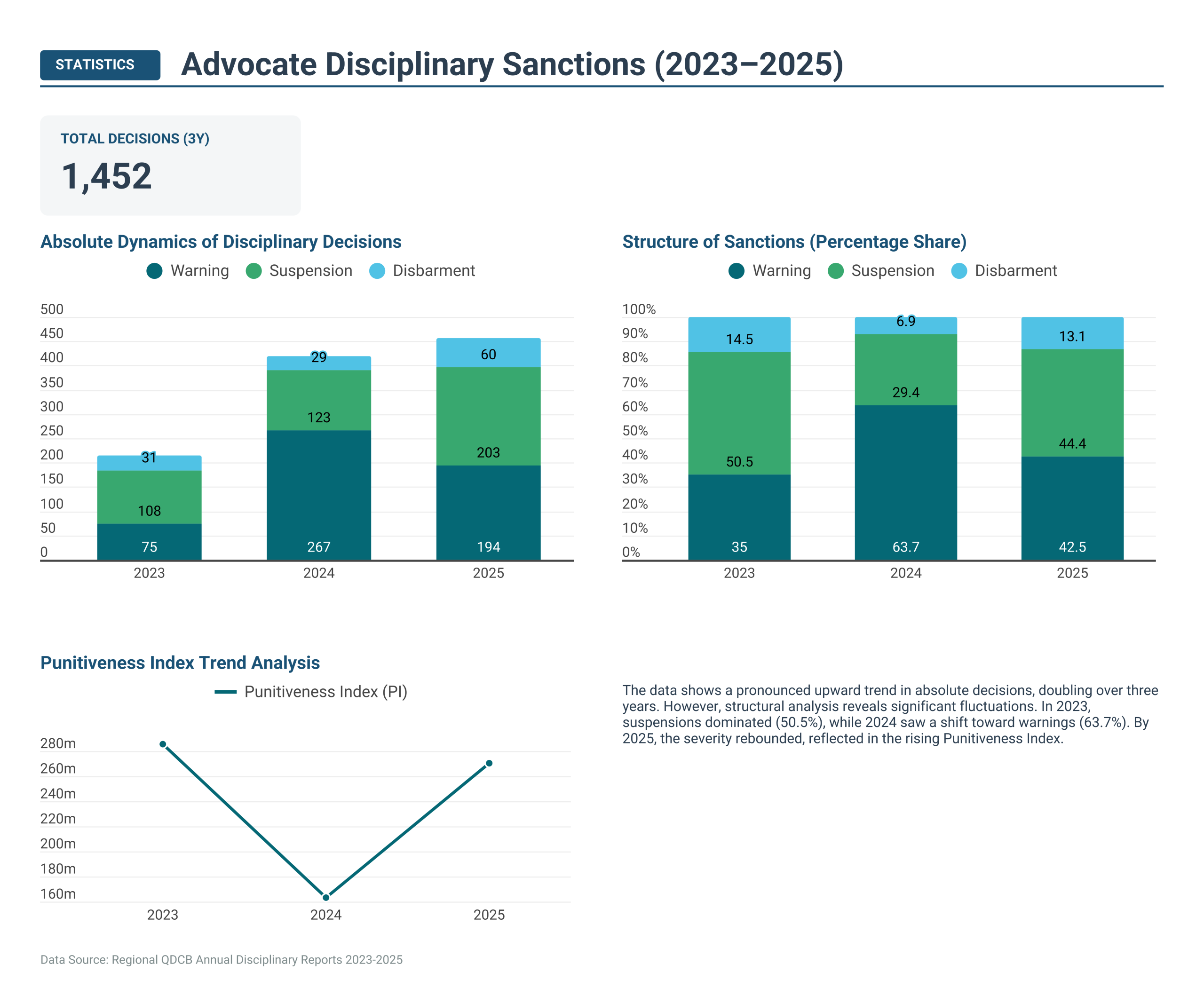
During 2023–2025, regional QDCBs imposed disciplinary sanctions on advocates in 1,452 cases. The total number of decisions imposing disciplinary liability on advocates over three years amounts to 1,452.
| Year | Total disciplinary decisions | Warning | Suspension of the right to practice | Disbarment | PI |
| 2023 | 298 | 75 | 108 | 31 | 0.285 |
| 2024 | 556 | 267 | 123 | 29 | 0.163 |
| 2025 | 598 | 194 | 203 | 60 | 0.270 |
| Total | 1,452 | 536 | 434 | 120 | 0.232 |
The dynamics show a pronounced upward trend in disciplinary decisions: from 298 in 2023 to 556 in 2024 and 598 in 2025 — a doubling over three years. However, absolute growth in itself is not evidence of an increase in the qualitative severity of disciplinary practice, as the analysis through the lens of the punitiveness index clearly demonstrates.
STRUCTURE OF SANCTIONS IN PERCENTAGE TERMS
For a deeper understanding of the dynamics of disciplinary practice, it is necessary to examine not only the absolute figures but also the relative share of each type of sanction in the overall structure.
| Year | Warning, % | Suspension, % | Disbarment, % | Total |
| 2023 | 35.0% | 50.5% | 14.5% | 100% |
| 2024 | 63.7% | 29.4% | 6.9% | 100% |
| 2025 | 42.5% | 44.4% | 13.1% | 100% |
| Overall | 49.2% | 39.8% | 11.0% | 100% |
Structural analysis reveals significant fluctuations in the proportions of the sanctions applied. In 2023, suspension of the right to practice dominated (50.5%), while the share of warnings was relatively low (35.0%). The most severe sanction — disbarment — accounted for 14.5% of the total.
In 2024, the picture changed dramatically: the share of warnings rose to 63.7%, the highest figure for the period under analysis. The shares of suspension (29.4%) and disbarment (6.9%) fell substantially. This shift towards the mildest sanction is what produced the lowest PI value for the entire period under analysis.
In 2025, the structure of sanctions was reconfigured once more: the share of warnings fell to 42.5%, while suspension of the right to practice reached its highest value over the three years — 44.4%. The share of disbarment also increased to 13.1%, indicating a partial return to stricter disciplinary logic compared with 2024.
PUNITIVENESS INDEX: ANNUAL DYNAMICS
Calculation of the punitiveness index yields a single integral indicator of the qualitative severity of disciplinary practice, independent of the absolute volume of sanctions applied.
| Year | n_medium (suspension) | n_serious (disbarment) | N (total decisions) | PI |
| 2023 | 108 | 31 | 298 | 0.285 |
| 2024 | 123 | 29 | 556 | 0.163 |
| 2025 | 203 | 60 | 598 | 0.270 |
| 2023–2025 | 434 | 120 | 1,452 | 0.232 |
The dynamics of the PI exhibit a non-linear character: 0.285 in 2023 → 0.163 in 2024 → 0.270 in 2025. The average value for the three-year period is 0.232, which corresponds to lenient disciplinary practice (the 0–0.25 range constitutes the lower boundary).
The highest PI was recorded in 2023 (0.285) — at the start of the period under analysis. The comparatively low number of sanctioning decisions in that year was combined with a relatively strict structure of sanctions: more than half (50.5%) involved suspension of the right to practice, and a further 14.5% involved disbarment. This suggests that in 2023 disciplinary bodies resorted less frequently to formal sanctions, but each sanction carried greater relative weight.
The sharp drop in the PI in 2024 (0.163) is the most striking phenomenon in the three-year dataset. Despite an almost doubling of the total number of decisions, there was a marked softening in the structure of sanctions. Two-thirds of all sanctions in that year were warnings — the least burdensome measure, which does not preclude continued legal practice. A likely explanation for this trend is the organisational expansion of QDCB disciplinary activity combined with the simultaneous application of a conservative (cautious) punitive logic as regards the type of sanction.
The recovery of the PI in 2025 (0.270) indicates a return to stricter disciplinary practice. It is notable that the increase in the PI occurred against a backdrop of a further rise in the total number of decisions, suggesting a simultaneous increase in both the quantitative and qualitative parameters of disciplinary activity.
SYSTEMIC PROBLEMS: OPACITY OF DATA AND NARROWNESS OF THE SANCTIONS TOOLKIT
The analysis by M. Bereza and Ya. Kuzyshyn records a critical institutional problem: the HQDCB declined to respond to the information request concerning its own decisions on annulling QDCB decisions. The absence of this data makes it impossible to calculate a ‘cleansed’ PI — that is, an indicator adjusted to account for those QDCB decisions that were overturned by the appellate body.
The existing narrowness of the sanctions menu may produce two opposing distortions in disciplinary practice: either excessive leniency (applying a warning where something stricter is warranted but not as severe as suspension of the right to practice) or excessive harshness (applying suspension of the right to practice in cases where an intermediate sanction would have sufficed). The problem is further compounded by the fact that the PI in its current form cannot distinguish between these two scenarios — for this purpose, data on the categories of proceedings and the grounds for applying specific sanctions are required.
CONCLUSIONS
The analysis conducted allows the following principal conclusions to be drawn.
First, the absolute increase in the number of disciplinary decisions concerning advocates for 2023–2025 is an incontrovertible fact. The total number of decisions doubled — from 298 to 598 per year. At the same time, this growth cannot be unambiguously interpreted as a tightening of disciplinary practice, since the qualitative structure of sanctions underwent substantial fluctuations during the same period.
Second, the punitiveness index is a more informative indicator than the absolute number of sanctions. The PI revealed non-linear dynamics (0.285 → 0.163 → 0.270) that remain invisible under purely quantitative analysis. Particularly telling is 2024, when the maximum number of decisions coincided with the minimum qualitative severity of sanctions.
Third, the average PI for the period under analysis (0.232) corresponds to lenient disciplinary practice (the 0–0.25 range is the lower boundary). This means that QDCBs generally apply relatively mild sanctions even taking into account the quantitative growth in activity. Given the structural limitations of the sanctions menu, this conclusion calls for further research incorporating the categories of violations.
Fourth, the opacity of HQDCB data is a critical problem for the quality of any analysis of disciplinary practice. The absence of information on the decisions of the appellate body makes it impossible either to verify the indicators presented or to adjust the PI. This in itself is evidence of the challenge of opacity that M. Bereza and Ya. Kuzyshyn describe.
Fifth, the expansion of the list of disciplinary sanctions for advocates is an urgent need that aligns with international standards and the draft Anti-Corruption Strategy for 2026–2030. Introducing additional types of sanctions (reprimand, fine, temporary prohibition of certain types of activity) would not only increase the proportionality of disciplinary decisions but would also enable better operationalisation of the PI as an analytical tool by providing it with a wider range of values.