
Complaints Against Robes: a Statistical Overview of Disciplinary Practices Within the Justice System of Ukraine
The article presents a comparative analysis of disciplinary complaints against lawyers, prosecutors, and judges in Ukraine for 2023–2025. Based on publicly available data from disciplinary bodies, it has been established that in both absolute and relative terms, lawyers are the least “complained-about” group among the three components of the justice system. At the same time, the author cautions against a simplistic interpretation of this data: the available figures reflect only the number of complaints filed, and in no way characterize the outcomes of their review.
INTRODUCTION AND STATEMENT OF THE PROBLEM
A comparative analysis of the disciplinary burden on these groups makes it possible to assess the actual state of accountability in the legal system and to identify structural imbalances requiring the attention of legislators and regulators. However, any such analysis requires a fundamental methodological caveat: data on the number of complaints filed represents only the input indicator of the disciplinary system and does not reflect its output results — the number of complaints upheld, sanctions imposed, or actual penalties applied.
Without this caveat, there is a serious risk of misinterpretation: a smaller number of complaints against a particular group may be perceived as evidence of that group’s better performance or higher standards of conduct. In reality, such a conclusion is methodologically unsound until the corresponding rates of complaint satisfaction and sanction application have been analyzed.
DATA SOURCES AND METHODOLOGY
The study is based on the publication by M. Bereza and Ya. Kuzyshyn (April 2026).
The size of the relevant groups (lawyers, prosecutors, judges) was determined on the basis of official registers and annual reports of the relevant bodies.
All relative indicator calculations were performed by the author.
For the purposes of this study, the concept of “active lawyers” is used — those whose right to practice law has not been suspended, terminated, or revoked. Using this subgroup as the base is methodologically justified, since only active lawyers are actually practicing and, accordingly, may be subject to disciplinary complaints.
| 2023 | 2024 | 2025 | Average | |
| Lawyers (total) | 67,871 | 70,152 | 72,454 | 70,159 |
| Active lawyers | 46,969 | 47,423 | 47,901 | 47,431 |
| Judges | 4,920 | 5,002 | 4,794 | 4,905 |
| Prosecutors | 9,978 | 9,907 | 9,902 | 9,929 |
ABSOLUTE INDICATORS OF DISCIPLINARY COMPLAINTS
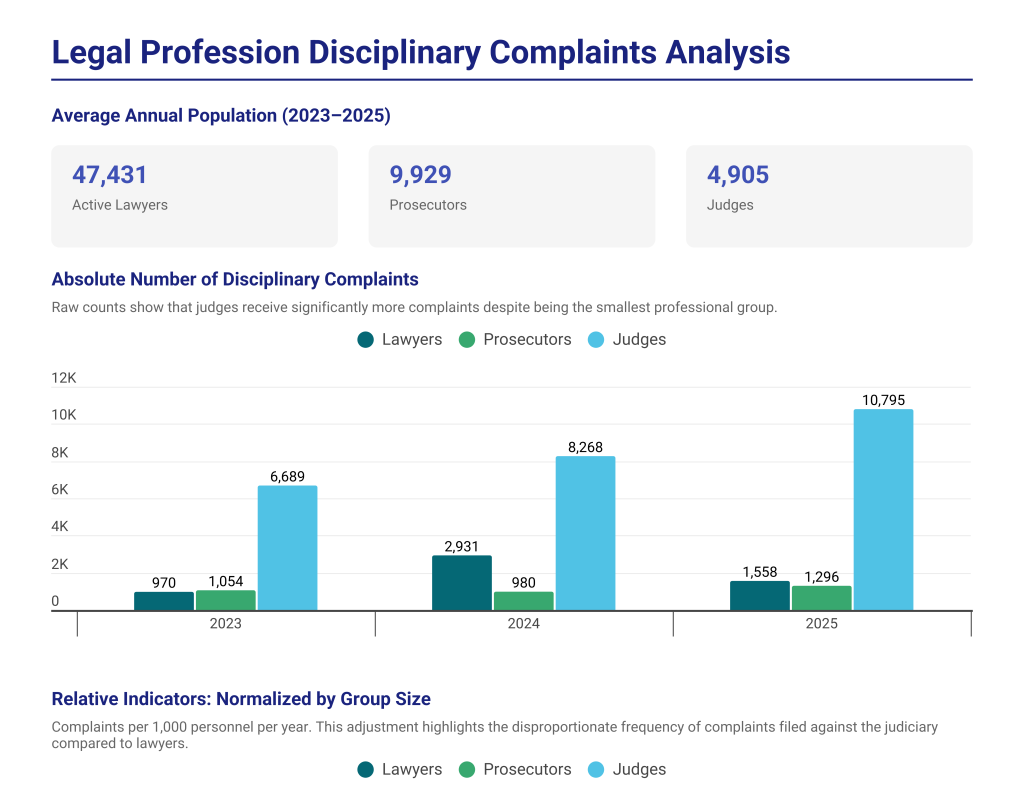
Over the period under analysis (2023–2025), 25,752 complaints were filed against judges, 5,459 against lawyers, and 3,330 against prosecutors. Thus, the number of complaints against judges is nearly 4.7 times greater than against lawyers, and 7.7 times greater than against prosecutors.
Attention should be drawn to the dynamics of complaints against lawyers: in 2024, their number increased more than threefold compared to 2023 (from 970 to 2,931), before declining to 1,558 in 2025. This anomalous peak may indicate a one-time surge in activity by particular complainants, changes in complaint procedures, or the influence of high-profile cases — but a more detailed analysis is required before definitive conclusions can be drawn.
| 2023 | 2024 | 2025 | Total | |
| Lawyers | 970 | 2,931 | 1,558 | 5,459 |
| Prosecutors | 1,054 | 980 | 1,296 | 3,330 |
| Judges | 6,689 | 8,268 | 10,795 | 25,752 |
RELATIVE INDICATORS: NORMALIZATION BY GROUP SIZE
Absolute figures are methodologically insufficient for comparing groups that differ significantly in size: the number of active lawyers is approximately 9.7 times greater than the number of judges and 4.8 times greater than the number of prosecutors. Therefore, for a valid comparison, the data must be normalized by the size of the respective groups.
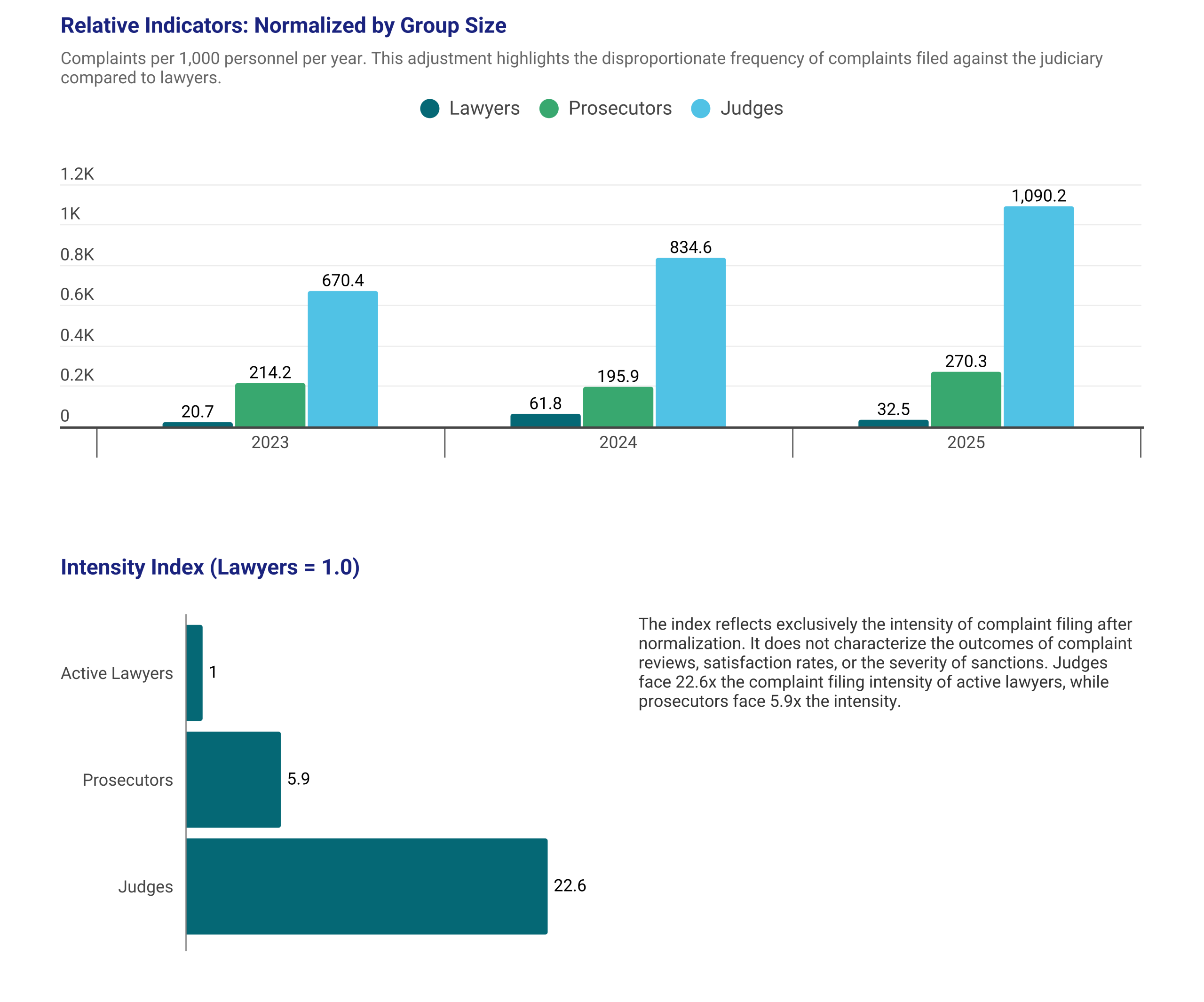
After such normalization, the picture becomes even more striking: on average, 38.3 complaints per year were filed per 1,000 active lawyers, compared to 226.8 per 1,000 prosecutors and 865.0 per 1,000 judges. The relative intensity index shows that prosecutors receive complaints 5.9 times more frequently than lawyers (per 1,000 persons), and judges 22.6 times more frequently.
Complaints per 1,000 persons per year
| 2023 | 2024 | 2025 | Average | |
| Active lawyers | 20.7 | 61.8 | 32.5 | 38.3 |
| Prosecutors | 214.2 | 195.9 | 270.3 | 226.8 |
| Judges | 670.4 | 834.6 | 1,090.2 | 865.0 |
The index below reflects exclusively the intensity of complaint filing after normalization by group size. It does not characterize the outcomes of complaint review, the rate of satisfaction, or the severity of sanctions applied. The comparison is based on data for 2023–2025; the base for active lawyers is an average of 47,431 persons, for prosecutors — 9,929, and for judges — 4,905.
| Index (lawyers = 1.0) | Explanation | |
| Active lawyers | 1.0× | Baseline |
| Prosecutors | 5.9× | 5.9 times more complaints per 1,000 persons |
| Judges | 22.6× | 22.6 times more complaints per 1,000 persons |
CRITICAL CAVEAT: COMPLAINTS ≠ ACCOUNTABILITY
The data presented, despite its significance, has a fundamental limitation that must be identified as an independent methodological caveat: all tables reflect exclusively the number of complaints filed and in no way characterize the outcomes of their review.
CONCLUSIONS
The analysis allows for the following conclusions.
First, in absolute terms for 2023–2025, judges are the group with the highest level of disciplinary complaints: 25,752 complaints were filed against them — nearly five times more than against lawyers (5,459 complaints).
Second, after normalization by group size, the relative disciplinary burden on judges is 22.6 times higher than on active lawyers; for prosecutors this figure is 5.9. This indicates a significantly higher intensity of use of disciplinary mechanisms against the judiciary.
Third, and this is the key finding of the study: the available data describes only the “input” of the disciplinary system (the number of complaints filed), not its “output” (outcomes of review, sanctions applied). In the absence of data on upheld complaints and actual penalties, any conclusion about the relative disciplinary well-being of any particular group remains methodologically unsupported.
Fourth, for a full assessment of the state of disciplinary accountability in Ukraine’s justice system, it is necessary to introduce unified and publicly accessible reporting by disciplinary bodies, which would include not only the number of complaints but also indicators of their outcomes broken down by type of sanction and category of violation.