
here are moments in a legal dispute when everything that should have worked simply did not. Three levels of national courts. Procedural correctness maintained throughout. Arguments made in good faith. And yet — refusal at every turn. Not because the law was on the other side, but because it sometimes does not matter who the law is on the side of.
If you have reached that point — or if you can see it approaching — the European Court of Human Rights is not an abstraction. It is a real institution, with real powers, capable of delivering what national courts have withheld: a binding finding that your rights were violated, and a remedy that the state is legally obliged to provide.
The question is not whether the ECtHR can help. The question is whether your case has been built in a way that allows it to.
THE ROAD TO STRASBOURG BEGINS LONG BEFORE THE APPLICATION
Most people think of the ECtHR as a last resort — something to consider after the final domestic judgment has been handed down. That instinct is understandable. It is also, in many cases, too late.
The Court in Strasbourg does not retry your case. It reviews whether the state — through its courts, its prosecutors, its institutions — violated the rights guaranteed under the European Convention on Human Rights. And it can only assess what was placed on the record in national proceedings. Arguments that were never made before domestic courts cannot be made for the first time in Strasbourg. Evidence that was never introduced cannot be relied upon. Violations that were never formally raised cannot be found.
Strategic preparation for the ECtHR begins at the first hearing of the national case — not after the last one. It means knowing, from the outset, which Convention rights are at risk, how to document their violation in real time, and how to frame domestic filings in a way that Strasbourg will recognise and be able to engage with.
This is not simply legal knowledge. It is a specific kind of experience — knowing how the Court reads applications, what it looks for, what it disregards, and how its practice has evolved. That experience is not widely available.
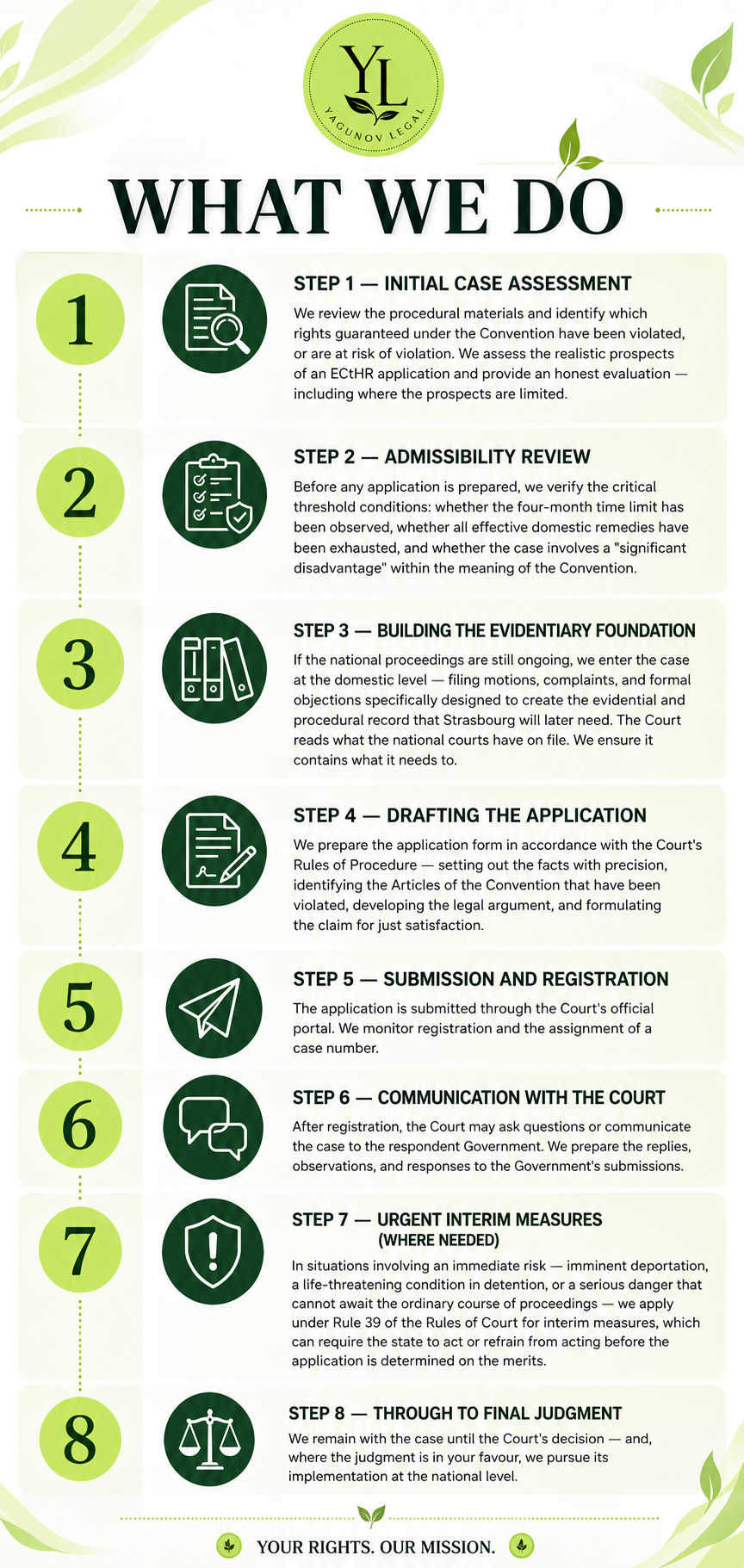
WHAT WE DO
Step 1 — Initial case assessment. We review the procedural materials and identify which rights guaranteed under the Convention have been violated, or are at risk of violation. We assess the realistic prospects of an ECtHR application and provide an honest evaluation — including where the prospects are limited.
Step 2 — Admissibility review. Before any application is prepared, we verify the critical threshold conditions: whether the four-month time limit has been observed, whether all effective domestic remedies have been exhausted, and whether the case involves a “significant disadvantage” within the meaning of the Convention.
Step 3 — Building the evidentiary foundation. If the national proceedings are still ongoing, we enter the case at the domestic level — filing motions, complaints, and formal objections specifically designed to create the evidential and procedural record that Strasbourg will later need. The Court reads what the national courts have on file. We ensure it contains what it needs to.
Step 4 — Drafting the application. We prepare the application form in accordance with the Court’s Rules of Procedure — setting out the facts with precision, identifying the Articles of the Convention that have been violated, developing the legal argument, and formulating the claim for just satisfaction.
Step 5 — Submission and registration. The application is submitted through the Court’s official portal. We monitor registration and the assignment of a case number.
Step 6 — Communication with the Court. After registration, the Court may ask questions or communicate the case to the respondent Government. We prepare the replies, observations, and responses to the Government’s submissions.
Step 7 — Urgent interim measures (where needed). In situations involving an immediate risk — imminent deportation, a life-threatening condition in detention, or a serious danger that cannot await the ordinary course of proceedings — we apply under Rule 39 of the Rules of Court for interim measures, which can require the state to act or refrain from acting before the application is determined on the merits.
Step 8 — Through to final judgment. We remain with the case until the Court’s decision — and, where the judgment is in your favour, we pursue its implementation at the national level.
A WORD ON WHAT THIS PRACTICE IS
Attorney Dmytro Yagunov has represented clients before the European Court of Human Rights for many years. The cases he has brought reflect a record built on cases that others had already lost in every domestic court.
He is currently based in Tübingen, Germany, as a research fellow at Eberhard Karls University under the Philipp Schwartz Initiative of the Alexander von Humboldt Foundation. He serves as Ukraine’s representative to the Council of Europe’s Committee for the Prevention of Torture — the body that conducts inspections of places of detention across 47 member states. That institutional role is not incidental to this practice. It means the cases he brings to Strasbourg are informed by a direct, working knowledge of how European human rights standards are applied, monitored, and enforced in practice.
ECtHR proceedings are slow. The process demands patience from clients, and honesty from counsel about how long it takes and what it can — and cannot — deliver. What it can deliver, for those whose cases meet the threshold, is something that 27 years of litigation across Ukraine’s courts has confirmed is genuinely rare: a decision from a court that is not part of the system that failed you.
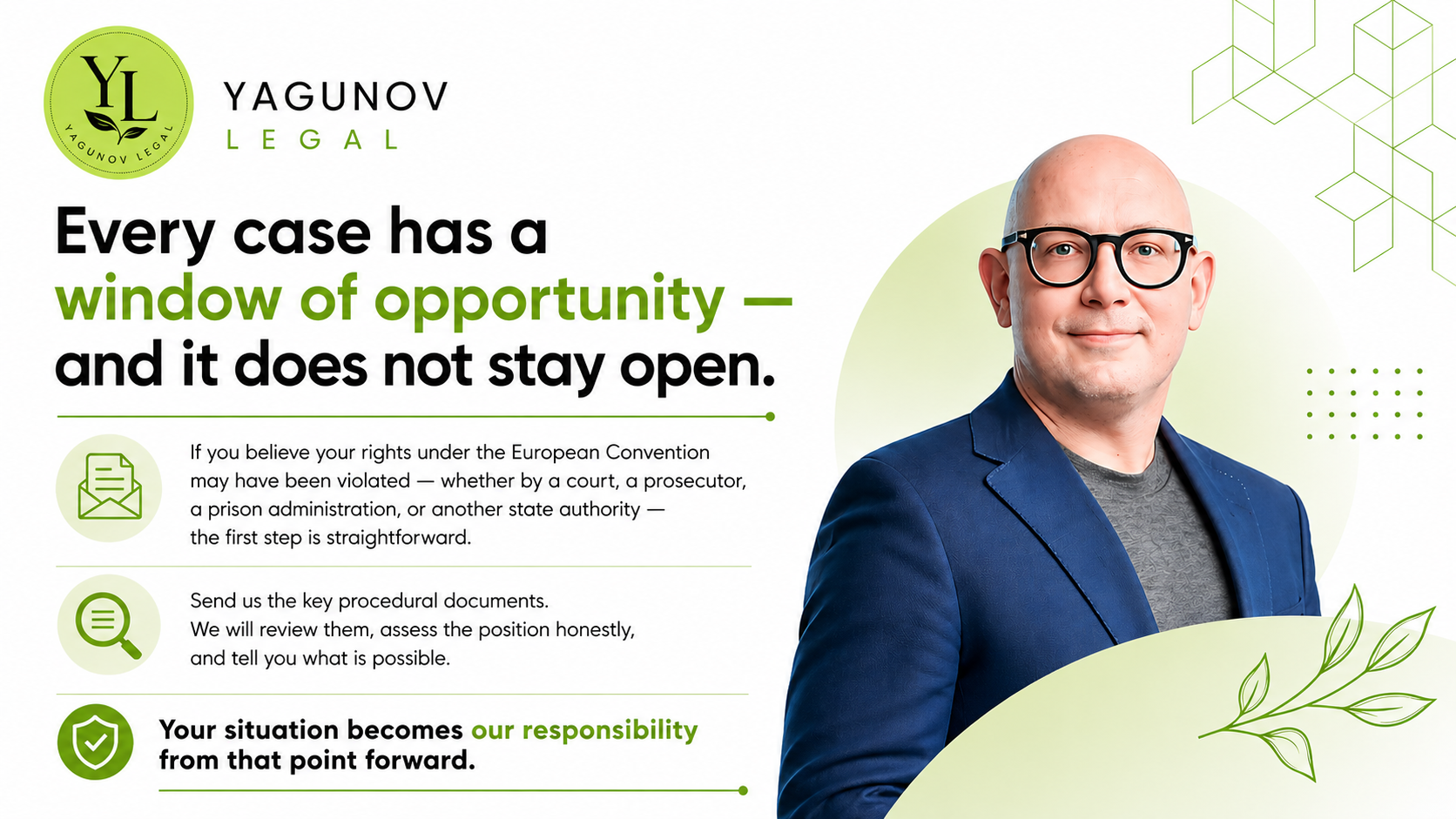
Every case has a window of opportunity — and it does not stay open
If you believe your rights under the European Convention may have been violated — whether by a court, a prosecutor, a prison administration, or another state authority — the first step is straightforward. Send us the key procedural documents. We will review them, assess the position honestly, and tell you what is possible.