
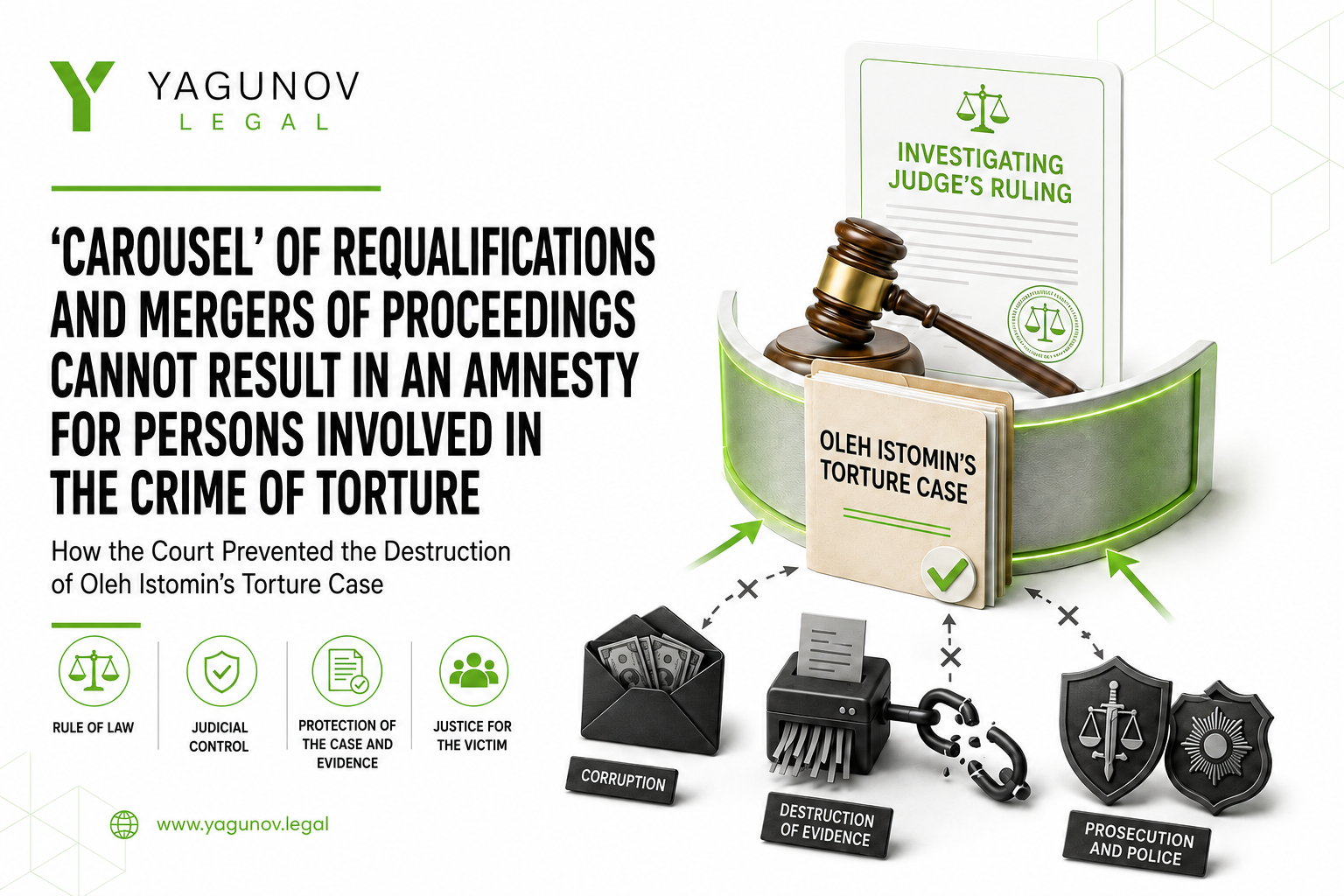
“Carousel” of Requalifications and Mergers of Proceedings Cannot Result in an Amnesty for Persons Involved in the Crime of Torture: How the Court Prevented the Destruction of Oleh Istomin’s Torture Case
On 31 July 2026, the investigating judge of the Bolhrad District Court of Odesa Oblast, S.V. Kodintseva, issued a ruling in case No. 497/150/22, by which she quashed the resolution of investigator V.V. Kilafly of the Investigative Division of the Bolhrad District Police Department of the Main Directorate of the National Police in Odesa Oblast to close criminal proceedings No. 12018160150002589 regarding the torture of Oleh Serhiiovych Istomin, committed on 30 September 2018 near the “Zeitun” bar in the city of Izmail.
This ruling deserves particular attention not merely as a procedural outcome, but as a striking example of how judicial oversight can halt years of sustained, systematic sabotage of an investigation into a serious crime by the law-enforcement bodies themselves.
As a result of the crime of torture committed against him, Istomin O.S. sustained a traumatic brain injury with signs of brainstem damage, which forensic medical examination report No. 132, issued by a panel of experts, classified as a serious bodily injury that was life-threatening when inflicted. The victim narrowly survived, and the consequences of the injury — disability, chronic headaches, panic attacks, memory impairment — he continues to suffer and will have to live with for the rest of his life. And it is precisely this — not some abstract procedural episode, but the real, documented torture of a human being — that for nearly eight years has still not received proper legal assessment.
HOW THE INVESTIGATION WAS TURNED INTO A TOOL FOR PROTECTING THE ATTACKERS
The ruling reconstructs the chronology of events in detail, step by step, and this chronology is, in essence, a textbook example of how, without formally breaching a single rule, it is possible in practice to make it impossible to hold those responsible to account.
The first episode of sabotage occurred immediately after the incident: in the first criminal proceeding opened, the investigators of the Izmail District Police Department never once — throughout the entire 12-month period allowed by law — applied to an investigating judge for an extension of the pre-trial investigation term, even though such a possibility existed and even though this concerned a grave crime against a person’s health. The investigation was effectively rendered meaningless from the very outset: time was lost for gathering evidence “while the evidence was still fresh,” and the victim himself received, in October 2018, a resolution closing the proceedings, which was later quashed on appeal by a prosecutor, who directly acknowledged that the investigation had been incomplete, not comprehensive, and conducted at a “low professional level.”
The second, decisive stage of sabotage took place at the end of 2021. In the parallel proceeding No. 12020160150000477 (concerning the same incident), the investigation had progressed considerably further and had even reached the stage of preparing notices of suspicion against specific individuals whom the victim had consistently named as his attackers.
Yet at precisely the moment when the term of this proceeding had not yet expired and the investigation had finally advanced on the merits, the deputy head of the Odesa Regional Prosecutor’s Office, D.A. Verbytskyi, by his resolution of 30 December 2021, merged this “living,” active proceeding with the “dead” proceeding No. 12018160150002589, which had by then effectively been closed to any action — assigning them a joint case number. The consequence of this merger was mathematically inevitable: the pre-trial investigation term, calculated on an aggregate basis, immediately exceeded the maximum 18 months then established by law, and within a few weeks, on 19 January 2022, investigator V.V. Kilafly issued a resolution closing the merged proceeding — ostensibly “forced” by the expiry of the term, even though it was precisely this merger that had been deliberately engineered.
The investigating judge states directly in her ruling: “The impossibility of continuing the pre-trial investigation in the merged criminal proceeding arose only after the decision was taken by the deputy head of the Odesa Regional Prosecutor’s Office, Verbytskyi D.A.,” meaning that it was the actions of the prosecutor’s office, and not any objective course of events, that made the closure of the proceeding inevitable.
The third level of sabotage — no longer procedural-technical but openly manipulative — became apparent in the very text of the closure resolution. The resolution is dated 19 January 2022, yet its reasoning section refers to a ruling of an investigating judge dated 26 January 2022 — that is, to a court decision which, on the date the resolution was drafted, did not yet physically exist. Moreover, the resolution cites a non-existent “paragraph 14 of part one of Article 284 of the CPC of Ukraine” — a provision that simply did not exist in the Code at the time the decision was taken. When this contradiction surfaced in 2026, investigator Kilafly V.V. — more than four years later — on 20 July 2026, on his own initiative, without any legal grounds whatsoever and outside the framework of any open proceeding, “corrected a clerical error,” retroactively changing the date of the resolution to 26 January 2022, in order to eliminate the chronological contradiction. The current CPC of Ukraine does not provide any legal procedure for correcting clerical errors in an investigator’s resolution.
The fourth level is the concealment of the very fact of the case closure from the victim. A copy of the resolution of 19 January 2022 was handed to attorney Yagunov D.V. only on 16 July 2026 — that is, four and a half years after it was issued, and only after eight (!) formal requests submitted by the victim’s lawyer and after judicial proceedings had been opened following a complaint. Over the course of two weeks in July 2026, nine state bodies — the Office of the Prosecutor General, the National Police, the Odesa Regional Prosecutor’s Office, the Izmail District Prosecutor’s Office, and the Izmail and Bolhrad District Police Departments — provided the victim’s representative with seven mutually contradictory, incomplete, or evasive responses: the very same official, in the very same week, at one point asserted that the proceeding had been closed and at another that it was still ongoing; one body denied the very existence of the resolution, while another body within the same system officially confirmed its existence. The investigating judge found these discrepancies to be independent evidence of the deliberate, rather than accidental, nature of the failure to provide the resolution to the victim.
HOW THE COURT STOPPED THIS MECHANISM
It is precisely in this context that the ruling of 31 July 2026 demonstrates what genuine judicial oversight of a pre-trial investigation ought to look like — as opposed to the formal rubber-stamping of the procedural decisions of the prosecuting authorities.
First, the court did not limit itself to examining the contested resolution alone, but examined the entire history of the proceeding in the original case materials — across four volumes — and established that the investigative body had never once applied for an extension of the term in the first proceeding, confining itself to the minimum 12-month term, whereas in the parallel proceeding the term had repeatedly been extended and the investigation had genuinely moved forward. This comparison gave the court grounds to conclude that the inaction had been selective, rather than accidental, in nature.
Second, the court found valid the reasons for missing the ten-day time limit for appealing the resolution, establishing that the victim and his representative had taken all available, good-faith, and repeated steps to obtain a copy of the resolution, while the pre-trial investigation and prosecution bodies had failed to provide any evidence of its having been served. In doing so, the court refused to treat the victim’s right to judicial protection as having “expired” in circumstances where it was the state itself, through its own bodies, that had made its timely exercise impossible.
Third, and this is the most fundamentally important point, the court directly characterized the resolution closing the proceeding not as an independent and self-standing procedural decision, but as “the logical result of a sequence of procedural actions (years of inaction, repeated changes of legal classification, the artificial merger of proceedings immediately before the expiry of the term)” aimed at an outcome directly prohibited by Articles 2 and 3 of the Convention for the Protection of Human Rights and Fundamental Freedoms. The court relied on the case-law of the European Court of Human Rights — Assenov and Others v. Bulgaria, Kaverzin v. Ukraine, Bouyid v. Belgium [GC], and, particularly tellingly, Marguš v. Croatia [GC] — formulating the conclusion that the prohibition of a de facto amnesty for torture applies not only to formal acts of pardon, but to any procedural mechanism which, in its practical effect, leads to the same result — making it impossible to hold the guilty accountable. “No number of closed and reopened resolutions, no ‘carousel’ of requalifications and mergers of proceedings can or should result in a de facto amnesty for persons involved in causing grave harm to the victim’s health,” the investigating judge stated directly — in essence applying to Ukrainian realities the concept of a “vicious circle” formulated by the Court in Kaverzin v. Ukraine: a systemic problem in which successive procedural decisions, despite formal quashing, never develop into a genuine investigation.
Fourth, the court did not content itself with a purely formal ground for quashing the resolution (the reference to a non-existent legal provision), although it did record this circumstance. Instead, it applied the legal position of the Criminal Cassation Court within the Supreme Court of 5 June 2025 (case No. 552/6926/23), according to which, in proceedings where the victim identifies a specific person as the attacker, the pre-trial investigation body is obliged to resolve, on the merits, the question of whether a criminal offence occurred, whether the person’s conduct constituted an offence, and whether the evidence was sufficient to prove that person’s guilt in court — rather than “discharging” itself of this obligation by invoking the expiry of the term in a proceeding whose investigation had been artificially halted from the very outset.
The outcome of the ruling is comprehensive: the court reinstated the time limit for the victim to challenge the decision, quashed the investigator’s resolution of 19 January 2022 closing the criminal proceeding (retroactively “corrected” to 26 January 2022) as unlawful and unsubstantiated, and returned the criminal proceeding materials to the prosecutor of the Bolhrad District Prosecutor’s Office of Odesa Oblast to organize the resumption of the pre-trial investigation. The ruling is not subject to appeal.
WHY THIS RULING MATTERS FOR ALL VICTIMS
This case illustrates a mechanism that is, unfortunately, not unique: an investigation drawn out over time, deliberately deprived of extension, then “merged” with another proceeding; closure of the case by invoking the expiry of the term instead of assessing the evidence on the merits; concealment of the very fact of closure from the victim for years; and, finally, an attempt to retroactively “adjust” the date on a document once the scheme began to unravel. Each of these steps, taken in isolation, might be attributed to negligence or an overburdened investigative apparatus. But the sequence and consistency of these actions, as established by the court — over the course of eight years, involving at least nine state bodies — rules out coincidence.
The investigating judge’s ruling of 31 July 2026 is valuable precisely because the court did not confine itself to a formal check of the lawfulness of a single document, but instead perceived and named the system — and applied to it the standards of Articles 2 and 3 of the Convention for the Protection of Human Rights and Fundamental Freedoms, under which the state’s obligation to investigate torture is autonomous, unconditional, and non-derogable, and cannot be “removed” by any number of procedural manipulations. This is an example of what judicial oversight of a pre-trial investigation should be: not the rubber-stamping of decisions by the investigator and prosecutor, but a genuine, independent, and professional review of whether the state has truly fulfilled its obligation to protect a person who has become the victim of a violent crime.
The ruling is published in full with the victim’s consent and at his express request, as a practical resource for anyone confronted with similar manifestations of corruption and investigative or prosecutorial sabotage.