
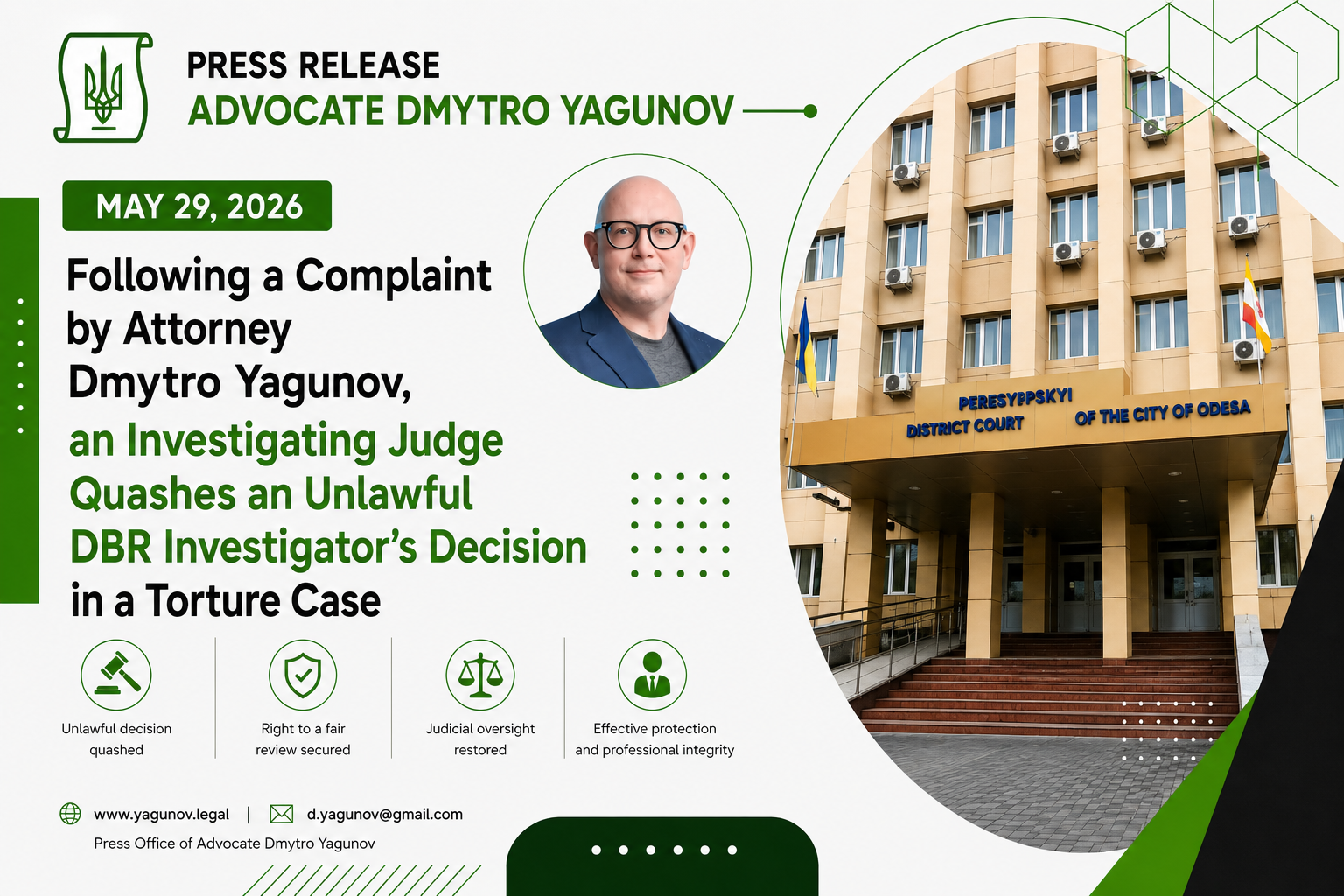
Following a Complaint by Attorney Dmytro Yagunov, an Investigating Judge Quashes an Unlawful DBR Investigator’s Decision in a Torture Case
On 20 August 2026, an investigating judge of the Peresypskyi District Court of Odesa granted a complaint filed by attorney Dmytro Yagunov and quashed an investigator’s decision refusing to grant victim status to a person who had been tortured by militia officers back in March 2013.
The facts of the case are simple, yet telling. Militia officers invited the man in for a “talk.” Instead, they beat him in public, in full view of numerous bystanders, causing bodily injuries whose effects he still feels and is still being treated for to this day.
More than a decade has passed since these events. Yet instead of an effective investigation, the victim has faced what can only be described as sustained sabotage: first by prosecutors of the Odesa Regional Prosecutor’s Office, who for years failed to ensure a proper examination of the torture complaints, and later by investigators of the Territorial Directorate of the State Bureau of Investigation in Mykolaiv, who, once the case reached them, refused to grant the victim that status, citing formal grounds that bore no relation to the actual state of the case file.
Attorney Dmytro Yagunov challenged this refusal before an investigating judge, arguing that the procedural status of a victim arises from the moment a crime report is filed, not from whatever suits the investigating authority or whenever it is ready to proceed. The investigating judge agreed with this position and quashed the investigator’s decision as unlawful and unfounded.
This ruling is an important, if intermediate, step. It does not conclude the case, but it restores the victim’s right to finally take full procedural part in the investigation into torture that the state was obligated to carry out back in 2013.
This case is yet another illustration of how fundamental the effectiveness of the response to ill-treatment truly is. The effectiveness of the action taken in response to instances of ill-treatment is an integral part of the prevention of ill-treatment. Trust in the declared prohibition of torture and other forms of ill-treatment is undermined every time officials responsible for such violations are not held accountable for their actions. If information indicating ill-treatment is not followed by a prompt and effective response, those inclined to subject detained persons to ill-treatment will quickly come to believe – with good reason – that they can do so with impunity. Conversely, when officials who order, authorise, condone, or perpetuate torture or ill-treatment are held accountable, this sends an unequivocal message that such conduct will not be tolerated.
Attorney Dmytro Yagunov continues to represent the victim’s interests and to pursue a full, independent, and effective investigation into this case.