
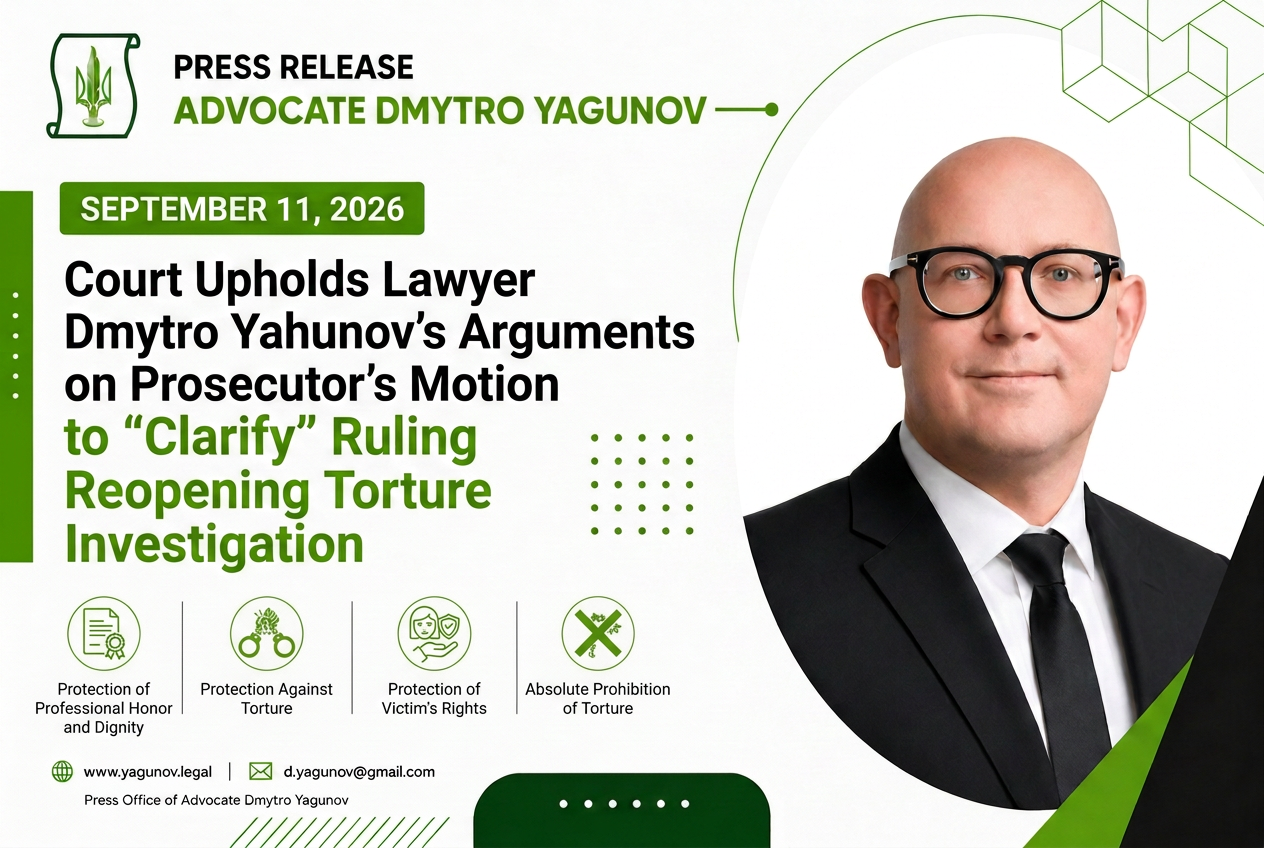
Court Refuses Prosecutor’s Request to “Clarify” The Ruling Reopening the Torture Investigation: The Ruling Is Clear, and The Prosecutor’s Application Is Sabotage
On 10 September 2026, investigating judge of the Bolhrad District Court of Odesa Region refused the application of prosecutor V.P.Bulhar of the Bolhrad District Prosecutor’s Office for clarification of the ruling of 31 July 2026 in case No. 497/150/22. By that ruling, the court quashed the investigator’s decision to close criminal proceedings No. 12018160150002589 and returned the materials to the prosecutor for the organisation of the pre-trial investigation.
The case concerns torture committed by a group of persons on the night of 30 September 2018 in Izmail: according to the conclusion of a commission forensic medical examination, the victim sustained a traumatic brain injury with damage to the brainstem, that is, grievous bodily harm dangerous to life. Despite this, in eight years no one has been notified of suspicion, and the proceedings were closed in 2018, 2019 and 2022. The last decision to close, dated 19 January 2022, referred to a court ruling of 26 January 2022, that is, to a decision which did not yet exist on the date the decision was drawn up. Quashing it on 31 July 2026, the court found that none of the minimum criteria of an effective investigation under Article 3 of the Convention had been met in these proceedings.
Instead of executing the ruling, prosecutor Bulhar V.P., more than a month after it was delivered, applied to the court asking it to “clarify” whether the direction “for the organisation of the pre-trial investigation” encompassed the conduct of investigative (search) and other procedural actions, or whether execution of the ruling “has a different procedural content” that does not envisage such actions. In other words, the prosecutor’s office asked the court to confirm that a ruling reopening an investigation could be executed without investigating.
In objections filed in the interests of the victim, advocate Dmytro Yagunov set out twenty arguments in support of the position that the prosecutor’s application was not an attempt to remove any genuine ambiguity in the judicial decision, but a manipulation aimed at obtaining unlawful judicial authorisation not to investigate the crime of torture. The ruling contains no unclear term; the prosecutor did not name a single specific investigative action allegedly obstructed by the “ambiguity”; in the month and a half since the ruling was delivered, not a single investigative action has been carried out, although during that same period the investigator herself was sending summonses to the victim, which means that for the investigating authority the ruling was entirely clear. The provision of paragraph 2 of Article 219 of the Criminal Procedure Code of Ukraine, on which the 2022 closure was based, has been removed from the Code since 1 January 2024 by Law No. 3509-IX, so no legal obstacle to the investigation exists.
The court fully agreed with the victim’s position. The investigating judge noted that the ruling of 31 July 2026 is set out in categorical, unambiguous terms, admits of no ambiguous interpretation and contains no unclear terms or legally indeterminate concepts, and separately found that there are no obstacles whatsoever to the conduct of the pre-trial investigation in these proceedings.
In the view of advocate Dmytro Yagunov, the prosecutor’s application is yet another episode in the sabotage of the investigation by the prosecutor’s office. Throughout 2026, the prosecutor’s office and the police concealed the decision to close the proceedings from the victim; defended the unlawful decision as “lawful and well-founded” right up until it was quashed by the court; made an unsuccessful attempt to change the investigative jurisdiction; and, after the decision was quashed, tried to turn a judicial decision intended to overcome years of inaction into a new legal justification for that very inaction. This sabotage takes on particular significance in light of circumstances the victim has repeatedly brought to the attention of the court and the investigating authorities: the existence of long-standing friendly ties between the prosecutors who exercised procedural supervision in these proceedings and the persons whom the victim identifies as having organised the attack and committed torture against him. In such circumstances, the evasion of the investigation by the prosecutor’s office is not negligence, but deliberate facilitation of impunity.
In Kaverzin v. Ukraine, the European Court of Human Rights recognised as a systemic problem of Ukraine the “vicious circle” in which formal quashings of decisions to close proceedings concerning ill-treatment do not lead to a genuine investigation. Advocate Dmytro Yagunov will continue to seek the substantive execution of the ruling, the bringing to justice of those involved in the torture, and a legal assessment of the conduct of the prosecutors who are sabotaging the investigation, including by way of an application to the European Court of Human Rights.