The UNBA Committee on Legal Ethics Started Working Over Official Interpretation Regarding the Possibility for Lawyers to Use Forged Documents
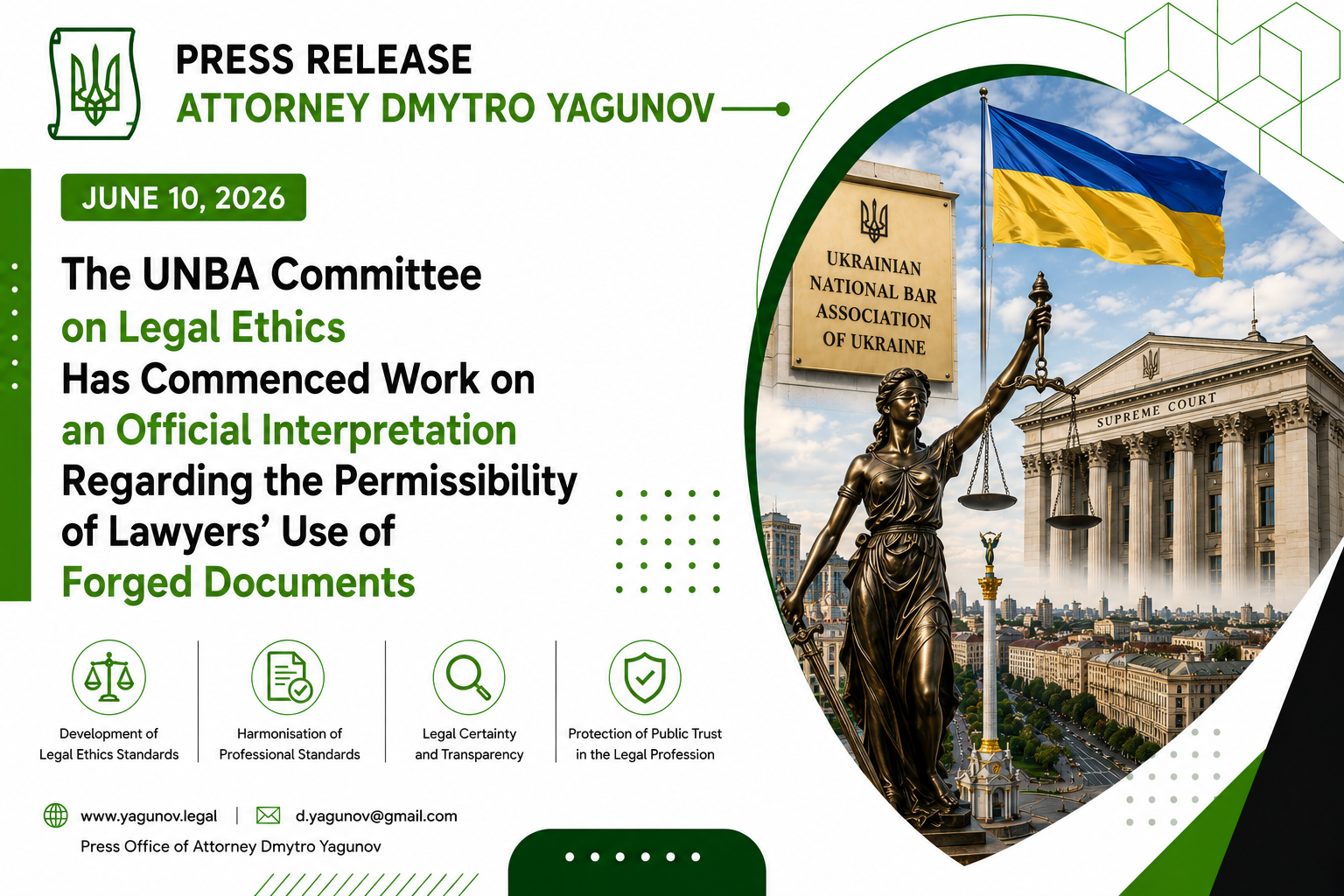
The National Bar Association of Ukraine (UNBA) has officially confirmed that the question of whether the use by advocates of documents of dubious legal origin complies with the Rules of Advocates’ Ethics has been referred for consideration to the specialised UNBA Committee on Advocates’ Ethics.
By letter No. 1191/0/2-26 of 10 June 2026, signed by Vadym Krasnyk, Head of the Secretariat of the National Bar Association of Ukraine (Secretariat of the Bar Council of Ukraine), it was communicated that the application submitted by advocate Dmytro Yagunov on 12 May 2026 (UNBA incoming No. 2163/0/1-26 of 13 May 2026), requesting clarification of the Rules of Advocates’ Ethics pursuant to Article 69 of the Rules of Advocates’ Ethics, has been forwarded for consideration, within the scope of its competence, to the UNBA Committee on Advocates’ Ethics, with a request to provide proposals on the issues outlined in the application.
SUBJECT MATTER OF THE APPLICATION
The application to the bodies of advocates’ self-governance raises the question of the normative and ethical qualification of two model situations which, regrettably, are not theoretical hypotheticals but a recurring practice in Ukrainian judicial proceedings:
Situation One. An advocate uses, in court proceedings or in the provision of legal assistance, a document whose sole signatory is a person who, at the moment of the document’s purported signing, was already biologically dead. The legal defect of such a document is absolute — it is subject neither to rectification nor to subsequent legalisation.
Situation Two. An advocate submits to a court, or relies upon in transactional practice, a title document whose very text expressly states that it was issued on the basis of a document officially recognised as forged. The defect of such a document is neither concealed nor debatable — it is recorded literally in the text of the very document the advocate is operating with.
With respect to each of these situations, specific questions have been put to the bodies of advocates’ self-governance: whether an advocate’s denial of the very fact of forgery complies with the Rules of Advocates’ Ethics; whether an advocate may accept and execute a client’s instructions that entail invoking the legal force of such documents; and whether each instance of submitting a document with a manifestly defective basis constitutes a separate disciplinary offence subject to consideration by the Qualification and Disciplinary Commission of the Bar (QDCB/KDKA).
SIGNIFICANCE FOR THE LEGAL PROFESSION
The systematic and unpunished use by individual advocates of documents with absolute legal defects directly discredits the Bar as an institution and erodes the trust of society and of European institutions in the legal profession in Ukraine. This problem has acquired an international dimension, in particular in view of the adoption by the European Court of Human Rights of relevant judgments against Ukraine.
The commencement of work by the UNBA Committee on Advocates’ Ethics on these questions is an important step towards the formation of clear, public, and binding standards of professional conduct. It is expected that the outcome of this consideration will be an official clarification that will render impossible any further tacit toleration of practices incompatible with the legal profession.
FOR REFERENCE
In parallel, analogous questions have been raised before the Bar Council of Ukraine and the Bar Council of Odesa Oblast by an application dated 3 June 2026 requesting official clarifications regarding compliance with the Rules of Advocates’ Ethics in cases of advocates’ use of documents of dubious legal origin.