
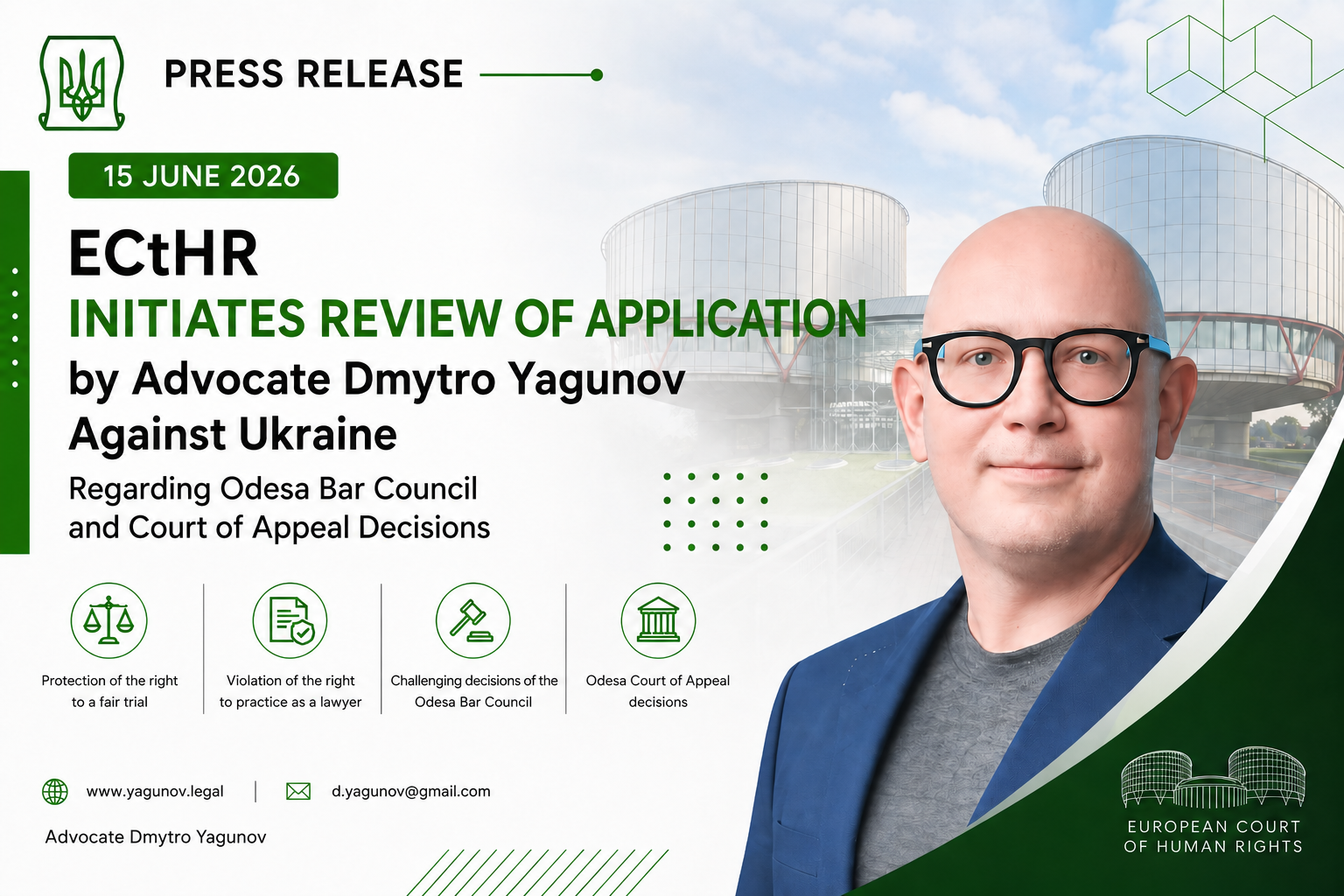
ECtHR Initiates Review of Application by Advocate Dmytro Yagunov Against Ukraine Regarding Odesa Bar Council and Court of Appeal Decisions
On 15 June 2026, the European Court of Human Rights commenced examination of the application lodged by advocate Dmytro Yagunov against Ukraine. The application concerns the systemic refusal of Ukrainian courts and bar self-governance bodies to recognise an advocate’s right to compensation for non-pecuniary damage caused by unlawful disciplinary prosecution.
BACKGROUND
On 26 June 2020, a complaint was lodged with the Qualification and Disciplinary Commission of Advocates of Odesa Oblast (KDKA) against advocate Yagunov D.V. in connection with his representation of clients in civil case No. 500/2395/18.
On 15 December 2020, the Disciplinary Panel of the KDKA of Odesa Oblast found advocate Yagunov D.V. guilty of a disciplinary offence and imposed a sanction in the form of a six-month suspension of the right to practise law.
By a ruling of the Fifth Administrative Court of Appeal dated 13 July 2021 in case No. 420/509/21, the aforementioned KDKA decision of 15.12.2020 was declared unlawful and quashed — in particular, due to a manifest conflict of interests on the part of commission members Ivanova P.V. and Pryshliak T.O. in favour of the complainant.
Notwithstanding this, on 30 November 2021 the KDKA of Odesa Oblast conducted a second examination of the same disciplinary case with the same composition of members and adopted a new decision that in substance upheld the finding of a disciplinary offence, closing the case solely on the grounds that the limitation period for imposing a sanction had expired.
By a ruling of the Supreme Court dated 30 November 2023 in case No. 420/27049/21, that decision was also declared unlawful and quashed: the Supreme Court held that no statutory authority existed for the KDKA to re-examine a disciplinary case following the judicial quashing of its initial decision. In the same ruling, the Supreme Court confirmed that the KDKA is a quasi-judicial body that exhibits all the characteristics of a “tribunal” within the meaning of Article 6(1) of the Convention for the Protection of Human Rights and Fundamental Freedoms.
THE CLAIM FOR NON-PECUNIARY DAMAGES AND THE COURTS’ DECISIONS
On 11 December 2023, advocate Yagunov D.V. brought a claim against the KDKA of Odesa Oblast seeking compensation of UAH 150,000 for non-pecuniary (moral) damage suffered as a result of two successive unlawful disciplinary decisions (case No. 522/23596/23-E).
By a judgment of the Prymorsky District Court of Odesa dated 2 October 2024 (Judge Naumenko A.V., proceedings No. 2/522/313/24), the claim was partially upheld — UAH 20,000 in non-pecuniary damages was awarded. The court found that the respondent’s actions had caused forced changes in the claimant’s life, inflicted moral suffering upon him, and damaged his professional reputation.
However, the KDKA of Odesa Oblast appealed the judgment.
By a ruling of the Odesa Court of Appeal dated 9 July 2025 (proceedings No. 22-ц/813/2722/25, panel composed of Presiding Judge Drahomeretskyy M.M. and Judges Hromik R.D. and Seheda S.M.), the first-instance judgment was overturned and the claims of advocate Yagunov D.V. were dismissed in their entirety.
The Court of Appeal grounded its refusal on a Supreme Court ruling of 20.03.2024 in case No. 522/8849/19, according to which the mere fact of quashing a KDKA disciplinary decision does not, in itself, demonstrate that damage was caused to the advocate. The Supreme Court refused to open cassation proceedings.
SUBJECT MATTER OF THE APPLICATION TO THE ECHR
The application by advocate Yagunov to the European Court of Human Rights targets the ruling of the Odesa Court of Appeal (Judges Drahomeretskyy M.M., Hromik R.D., Seheda S.M.) and the subsequent position of the Supreme Court, which established a de facto immunity of bar self-governance bodies from civil liability even in cases where their decisions were adopted with a conflict of interests, in breach of procedure, and in contravention of ECtHR case law.
The legal situation described is incompatible with Articles 6, 8, and 13 of the Convention for the Protection of Human Rights and Fundamental Freedoms, as well as with its First Protocol.
COMMENTARY
This case raises a fundamental question: can a bar self-governance body — recognised by the Supreme Court of Ukraine as a quasi-judicial body within the meaning of Article 6 of the Convention — be entirely exempted from any liability for unlawful decisions taken under conditions of a proven conflict of interests and in violation of fundamental procedural guarantees? The answer of the European Court of Human Rights will be significant not only for this particular case, but for the state of the rule of law within the bar self-governance system of Ukraine as a whole.