
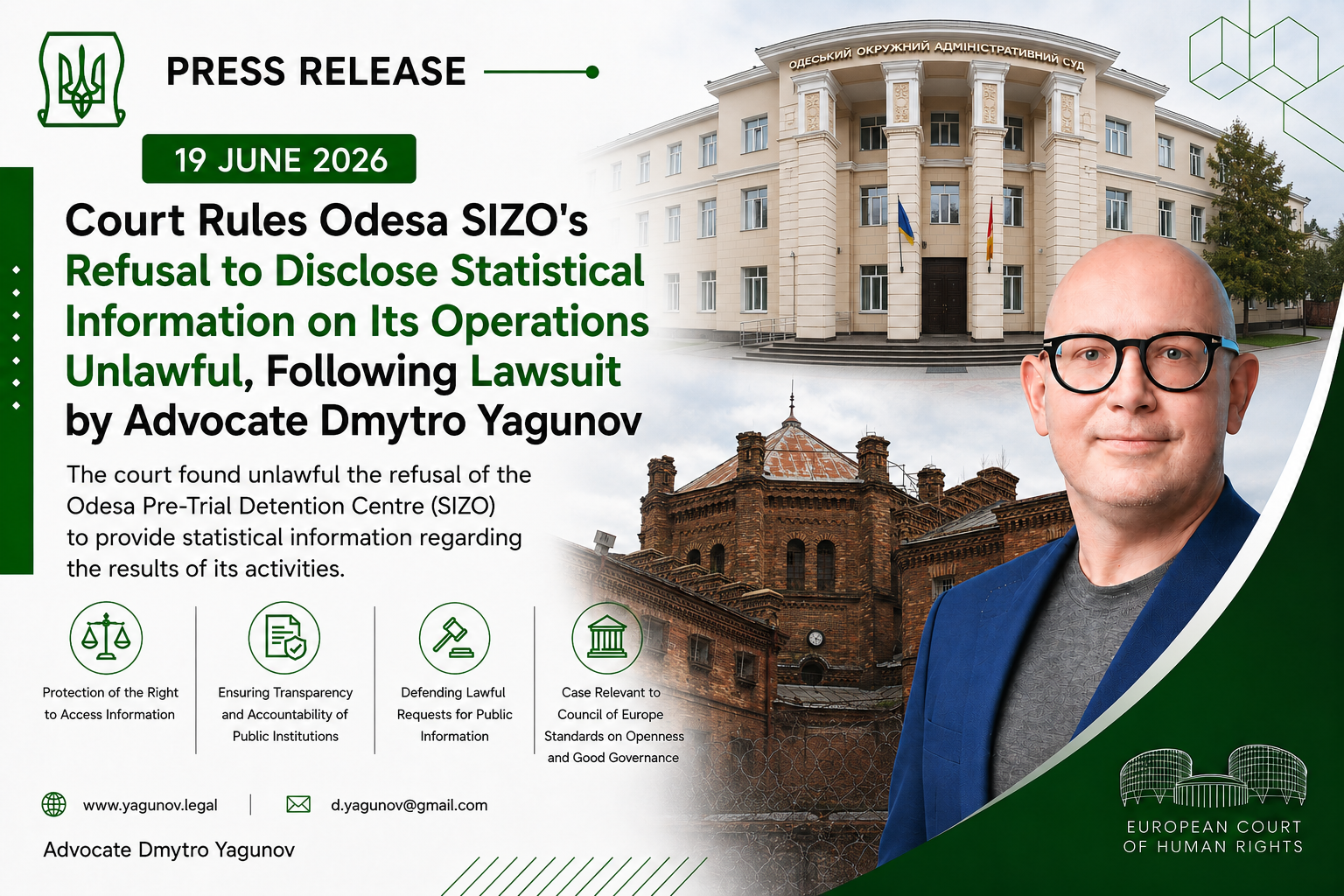
Court Rules Odesa SIZO’s Refusal to Disclose Statistical Information on Its Operations Unlawful, Following Lawsuit by Advocate Dmytro Yagunov
The Odesa District Administrative Court, by its judgment of 19 June 2026 in case No. 420/9112/26, granted in full the claim brought by advocate Dmytro Yagunov against the State Institution “Odesa Pre-Trial Detention Centre” and the South-Central Interregional Directorate for the Execution of Criminal Sentences of the Ministry of Justice of Ukraine.
THE SUBJECT MATTER OF THE CASE
In March 2026, the advocate submitted an information request to the respondents seeking statistical data on the operation of the Odesa SIZO over the period 2010–2026, covering nine groups of questions: general information about the institution; conditions of detention and material and living provision; medical care; mortality and emergency events; the use of physical force and special means; disciplinary penalties; staffing matters; criminal activity within the institution; and the rights of particular categories of persons (minors, women, persons with disabilities, and foreign nationals).
Both information holders refused, asserting that the requested data purportedly “did not constitute public information” and would require “the creation of new information.”
THE COURT’S FINDINGS
The court rejected the respondents’ arguments as erroneous. It emphasised that data on the staffing, structure, and budget of the institution are directly classified by law as public information, access to which may not be restricted under any circumstances. Information on mortality, the use of force, overcrowding, disciplinary penalties, and emergency events is, in turn, subject to mandatory recording under the Law “On Pre-Trial Detention” — and is therefore documented and already in existence. A large volume of information and the absence of a “ready-made consolidated document” do not constitute a lawful ground for refusal.
The court specifically noted that the respondents had selectively and incorrectly applied the criteria formulated by the Grand Chamber of the ECtHR in Magyar Helsinki Bizottság v. Hungary, and took into account the ECtHR judgment in Ukrayinskyy and Others v. Ukraine (02.04.2026), which found a structural problem of opacity surrounding conditions of pre-trial detention in Ukraine. The court underlined that the requested information is of substantial public character and requires public scrutiny.
The court ordered both institutions to reconsider the request in accordance with the procedure established by law and awarded the court fee against each respondent in the claimant’s favour.
WHAT COMES NEXT
The judgment may be challenged on appeal. Should the Odesa SIZO choose to continue shrouding its operations in darkness — particularly against the backdrop of high-profile allegations of ill-treatment and torture in this institution — the defence is prepared to uphold the claimant’s position before the court of appeal. The public’s right to know what takes place behind the walls of a pre-trial detention centre cannot depend on the administration’s willingness to conceal it. Transparency of the penitentiary system is not “new information,” but a constitutional duty of the State.