
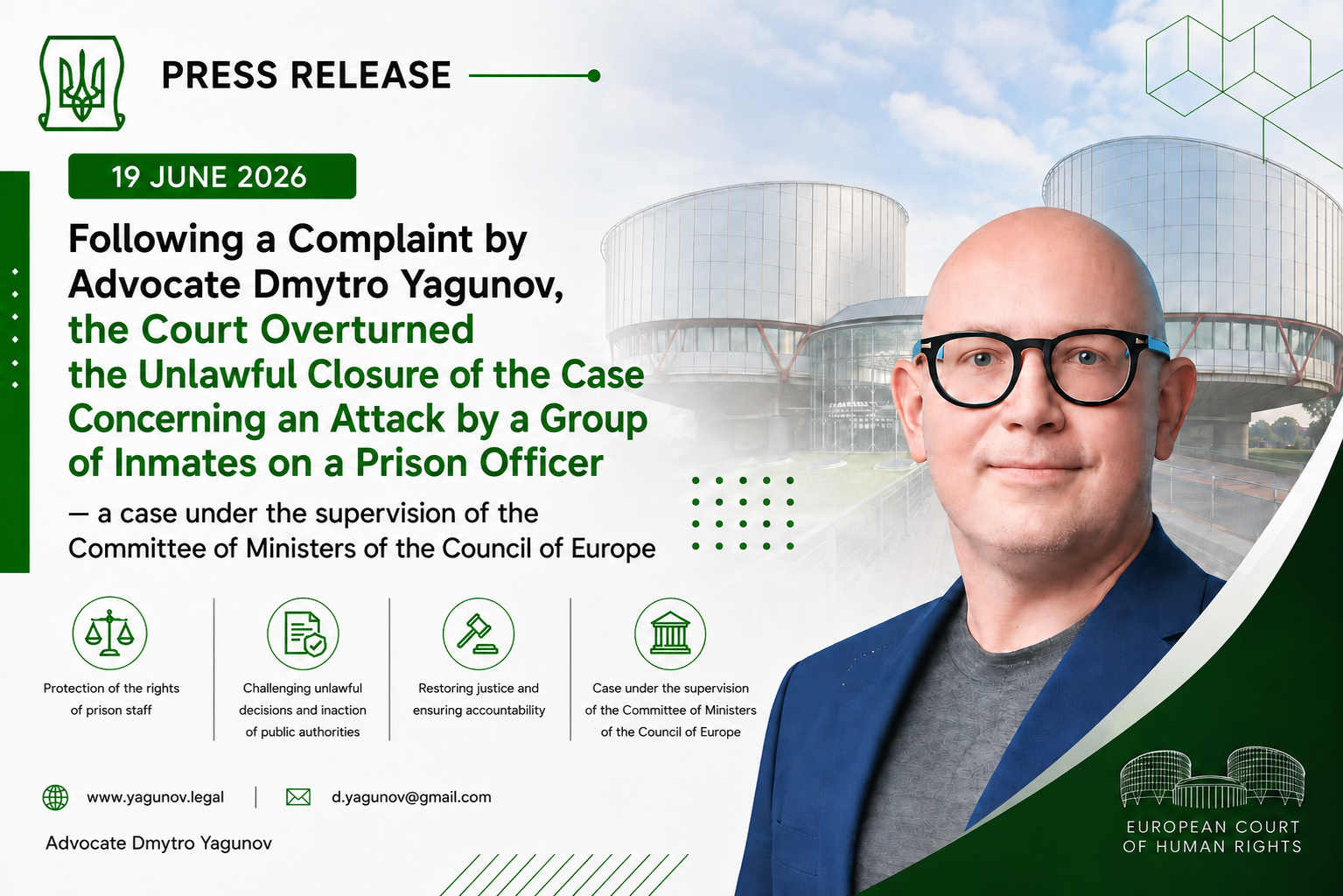
Following a complaint by advocate Dmytro Yagunov, the court overturned the unlawful closure of the case concerning an attack by a group of inmates on a prison officer — a case under the supervision of the Committee of Ministers of the Council of Europe
On 19 June 2026, the investigating judge of the Shevchenkivskyi District Court of the city of Kyiv, acting on a complaint by advocate Dmytro Yagunov, quashed the police investigator’s decision to close the criminal proceedings concerning an attack by a group of inmates on an employee of the Kyiv pre-trial detention centre (SIZO).
The attack was committed back on 1 January 2017: a group of inmates, using a metal rod, inflicted serious injuries on an employee of the facility who was at his workplace performing his official duties. The investigation lasted more than eight years and never resulted in anyone being served with a notice of suspicion.
On 30 April 2026, the European Court of Human Rights delivered its final judgment in the case of Sklyarenko v. Ukraine (application No. 18277/18), in which it unanimously found a violation of the procedural limb of Article 3 of the Convention: the State had failed to discharge its obligation to conduct an effective investigation; after September 2018 no meaningful investigative steps had been taken; and responsibility for the delays was attributed primarily to the national authorities. Execution of this judgment is under the supervision of the Committee of Ministers of the Council of Europe.
Notwithstanding the existence of a final ECtHR judgment, on 8 June 2026 the police investigator closed the proceedings — purportedly for the absence of the constituent elements of a criminal offence, that is, on exculpatory (rehabilitating) grounds. This decision was taken in defiance of the body of evidence gathered, including the confessional statements of persons implicated in the attack.
The legal consequences of such closure are systemic. Instead of remedying the “ineffective investigation” found by the Court, the State has effectively transformed it into the “absence of any investigation at all,” rendering the established violation irreversible. The persons who attacked an employee of a penitentiary institution have de facto been granted impunity, and the informal criminal hierarchy in places of detention has received an unequivocal signal of impunity. It was precisely the reproduction and entrenchment of “prison law” (the thieves’ code) and the informal hierarchy among inmates that lay at the heart of the circumstances of the attack; the closure of such proceedings on rehabilitating grounds objectively legitimises this phenomenon in the country’s largest pre-trial detention centre.
We separately emphasise: the Office of the Prosecutor General and the Kyiv City Prosecutor’s Office — having direct authority to set aside the investigator’s unlawful decision through prosecutorial supervision — declined to do so of their own motion, despite the corresponding application by the defence and despite the binding force of the ECtHR judgment. Legality could be restored only through judicial means — by way of a complaint to the investigating judge.
“Closing on rehabilitating grounds a case that is under the supervision of the Committee of Ministers of the Council of Europe would mean that the State sanctions the impunity of those who dominate the informal prison hierarchy. Today’s decision of the investigating judge returns the investigation to the legal framework,” advocate Dmytro Yagunov noted.
Advocate Dmytro Yagunov will continue to press for an effective investigation and for the proper execution of the ECtHR judgment, including within the framework of the supervisory procedure of the Committee of Ministers of the Council of Europe.