
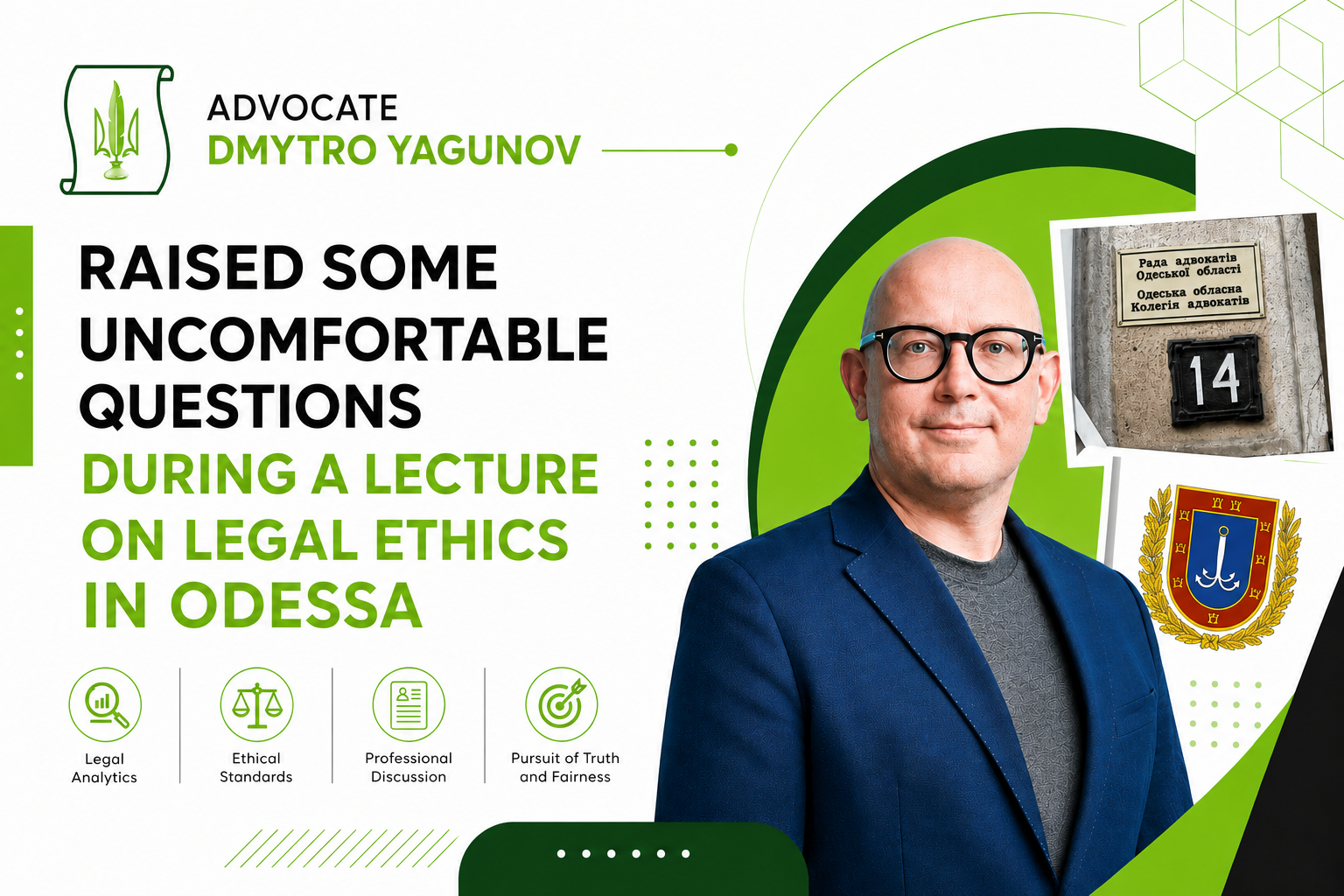
Advocate Dmytro Yagunov Raised Some Uncomfortable Questions During a Lecture on Legal Ethics in Odessa
22 May 2026, the Bar Council of Odesa Oblast hosted a lecture entitled “Rules of Legal Professional Ethics: Trends in Development and Current Issues.” Advocate, Doctor of Political Sciences, and Honoured Lawyer of Ukraine Dmytro Yagunov used the occasion to raise systemic questions regarding the compliance of the KDKA Odesa Oblast’s practice with the standards of the Convention for the Protection of Human Rights.
THE EVENT AND ITS CONTEXT
The lecture was delivered by Doctor of Law, Head of the Department of Law Enforcement Organisation at the National University “Odesa Law Academy,” and Secretary of the Disciplinary Chamber of the KDKA Odesa Oblast, Nana Mizeniivna Bakayanova. One may acknowledge the high professional calibre of the speaker and the value of the initiative itself. At the same time, in Yagunov’s assessment, the event clearly exposed systemic problems in disciplinary practice that require public discussion.
KEY ISSUES RAISED BY ADVOCATE DMYTRO YAGUNOV
1. The status of the KDKA as a “tribunal” under Article 6 of the Convention
The ECtHR recognises bar disciplinary tribunals as courts within the Convention’s meaning, which automatically extends to the KDKA the guarantees of a fair hearing: adversarial proceedings, equality of arms, independence, and impartiality.
2. Combining the roles of prosecutor and judge
The current procedure provides that a single member of the commission both prepares a case and votes on it — which may constitute a gross violation of Article 6 standards of the Convention.
3. The complainant’s absence and the advocate’s right to a defence
The examination of a disciplinary matter in the absence of the complainant deprives the advocate of the opportunity to put questions and refute the accusations — amounting to a violation of the right to a defence.
4. The KDKA legal adviser’s reports as evidence
Advocate Dmytro Yagunov drew attention to a precedent in which a disciplinary sanction was founded upon a report prepared by the KDKA’s legal adviser after proceedings had already been initiated. The question of the admissibility of such a practice went unanswered.
5. Paper notifications under martial law
The KDKA Odesa Oblast has yet to introduce mandatory electronic notification of advocates regarding hearings. Against the backdrop of chronic postal difficulties and the ongoing state of martial law, this practice — when combined with sanctions for non-attendance — represents a departure from the right of access to a tribunal.
6. An advocate’s use of forged documents
The central question that went unanswered by the Secretary of the Disciplinary Chamber was: does the use in court of a document signed by a person who, according to numerous judicial decisions, had died prior to the date of its signing constitute a breach of professional ethics?
7. Citing Pushkin in the context of legal professional ethics
Dmytro Yagunov raised the question of the ethical propriety of invoking Pushkin as an authority on legal and moral matters, pointing to the use of this figure by the Kremlin to deny the distinctiveness of Ukrainian identity.
THE ACCESSIBILITY PROBLEM: ONLINE PARTICIPANTS WITHOUT A VOICE
Advocate Yagunov also drew attention to a structural issue with the event’s format: online participants were deprived of the opportunity to take a full part in the discussion — questions submitted via the chat function were disregarded. In wartime conditions, when a significant proportion of advocates are located abroad or in other regions, the absence of equal access to continuing professional education constitutes a systemic problem.
CONCLUSION
The lecture was substantive and reflects the speaker’s genuine professional expertise. However, if the KDKA Odesa Oblast truly aspires to align itself with European standards, the issues raised during the event cannot be ignored. Each of them has a concrete procedural dimension and affects the real circumstances of practising advocates.